
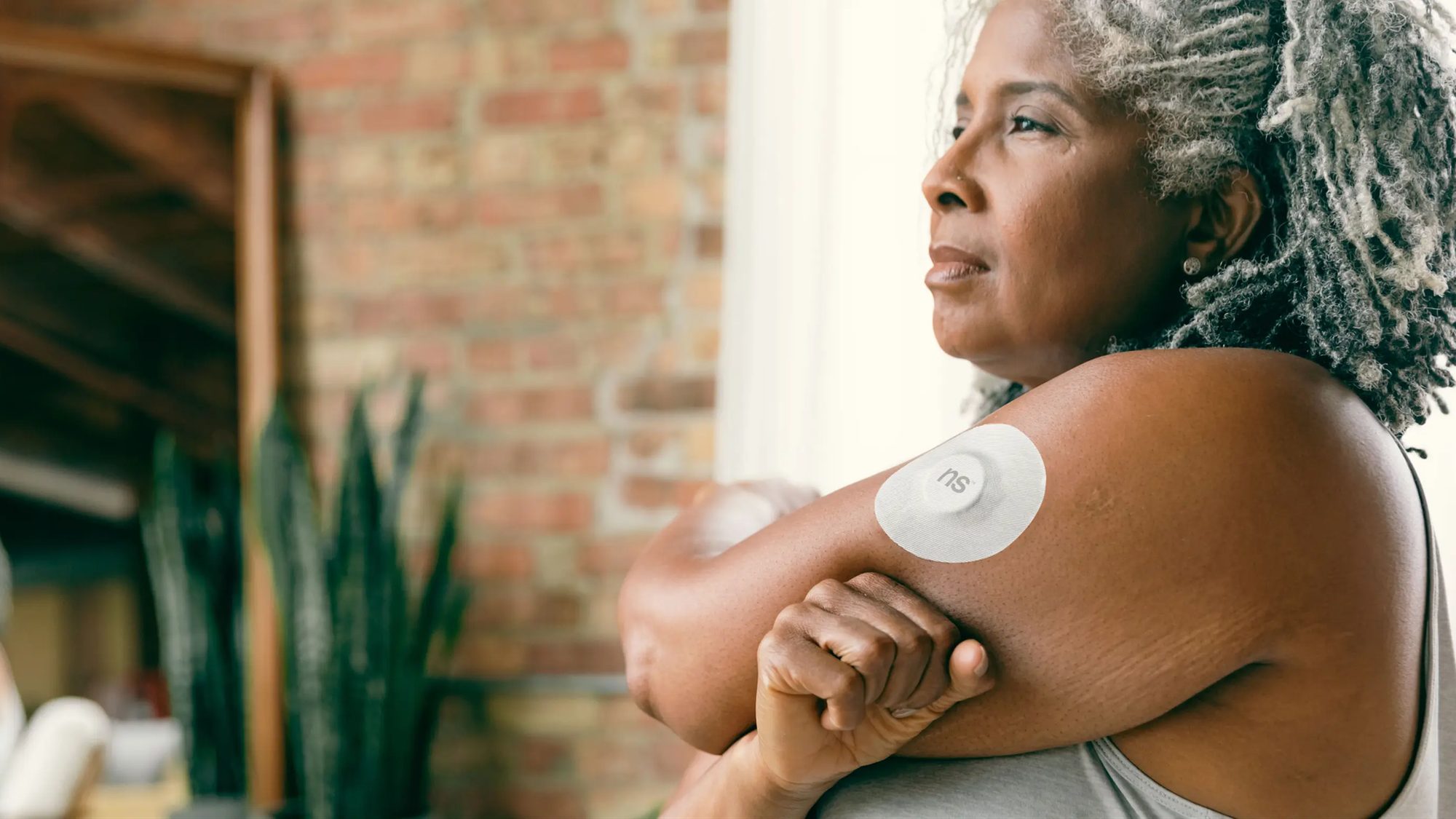
Continuous glucose monitoring: What a CGM sensor reveals about your metabolism
Continuous Glucose Monitors, or CGMs, were originally developed for people with diabetes — but biohackers use them to see in real time how their body responds to meals, exercise, and sleep. What they show and what their limits are.
What a CGM is and how it works
A Continuous Glucose Monitor is a small patch system with a thin needle electrode that you insert under your skin — usually on the upper arm or abdomen. The sensor measures the glucose level in the tissue fluid, the interstitial fluid, and transmits the values every one to five minutes via Bluetooth to your smartphone.
Important to understand: CGM does not measure blood sugar directly, but glucose in interstitial fluid. This introduces a slight time lag and can trail blood sugar by 10 to 15 minutes during rapid changes — for example, immediately after an intense workout. For trend assessments over hours, this is not an issue; for acute medical decisions, it can be.
What you learn from a CGM in biohacking
The main advantage of CGM is real-time feedback: you can see in the curve how your blood sugar rises after different meals and how quickly it comes back down. White bread, a breakfast with oats, or the same food eaten in a different order — the glucose curve makes visible what would otherwise stay hidden.
Studies by the group around Tim Spector showed that individual glucose responses to identical meals vary considerably. What spikes your blood sugar sharply may cause barely a ripple in someone else — depending on microbiome, insulin sensitivity, and genetics. A CGM makes this personalised observation possible.
Other patterns you can observe: the so-called dawn effect — a natural glucose rise in the early morning hours driven by cortisol and growth hormones. Or how exercise lowers blood sugar — though intense training can also cause a short-term rise, because stress hormones mobilise glucose.
What the research says about CGM use in non-diabetics
Most CGM studies have been conducted on people with type 1 and type 2 diabetes, where the benefit is clearly established. For metabolically healthy individuals, the evidence is thinner.
A study in Nature Medicine by Hall et al. showed that healthy adults spent more time with blood sugar levels above 140 mg/dl on average than previously assumed — raising questions about normal glucose dynamics. So far, however, there are no randomised studies showing that CGM use improves health outcomes in healthy individuals.
Practical matters: availability, cost, wearing
Sensors such as the Libre 3 or Dexcom G7 are available without a prescription in many countries. They typically last 14 days, after which a new sensor is applied. Costs vary; for a two-week self-experiment, the investment is manageable.
Wearing the sensor is straightforward for most people — the needle is very fine and insertion is barely noticeable. Water, exercise, and showering pose no problem. The app connectivity is stable with the common systems.
A CGM does not replace a medical diagnosis and is not a medical device for healthy individuals. It is an observation tool — with the corresponding benefits and limitations.
CGM and the YUTHI app
You can log your CGM data — fasting glucose, post-meal peaks, daily average — in the YUTHI app as biomarker measurements and link them with other parameters such as training, sleep quality, and nutrition. This lets you spot patterns that are not visible in the CGM app alone.
If you run a 14-day self-experiment, you can document it as a biohacking experiment in the app and compare the results with your baseline biomarkers at the end of the period. This makes your observations actionable and helps you make informed decisions — rather than going with your gut feeling.
That was the snapshot. The app turns it into daily support.
Measure every day instead of calculating once: Vito or Vita puts your numbers in context, builds you a weekly plan and speaks up when something stands out.
Launching at the end of 2026 — iPhone first, Android to follow. Let me know when it’s out ↓
Sources
- Hall H et al. Glucotypes reveal new patterns of glucose dysregulation. PLOS Biology, 16(7):e2005143, 2018.
- Zeevi D et al. Personalized nutrition by prediction of glycemic responses. Cell, 163(5):1079–1094, 2015.
- Danne T et al. International consensus on use of continuous glucose monitoring. Diabetes Care, 40(12):1631–1640, 2017.