
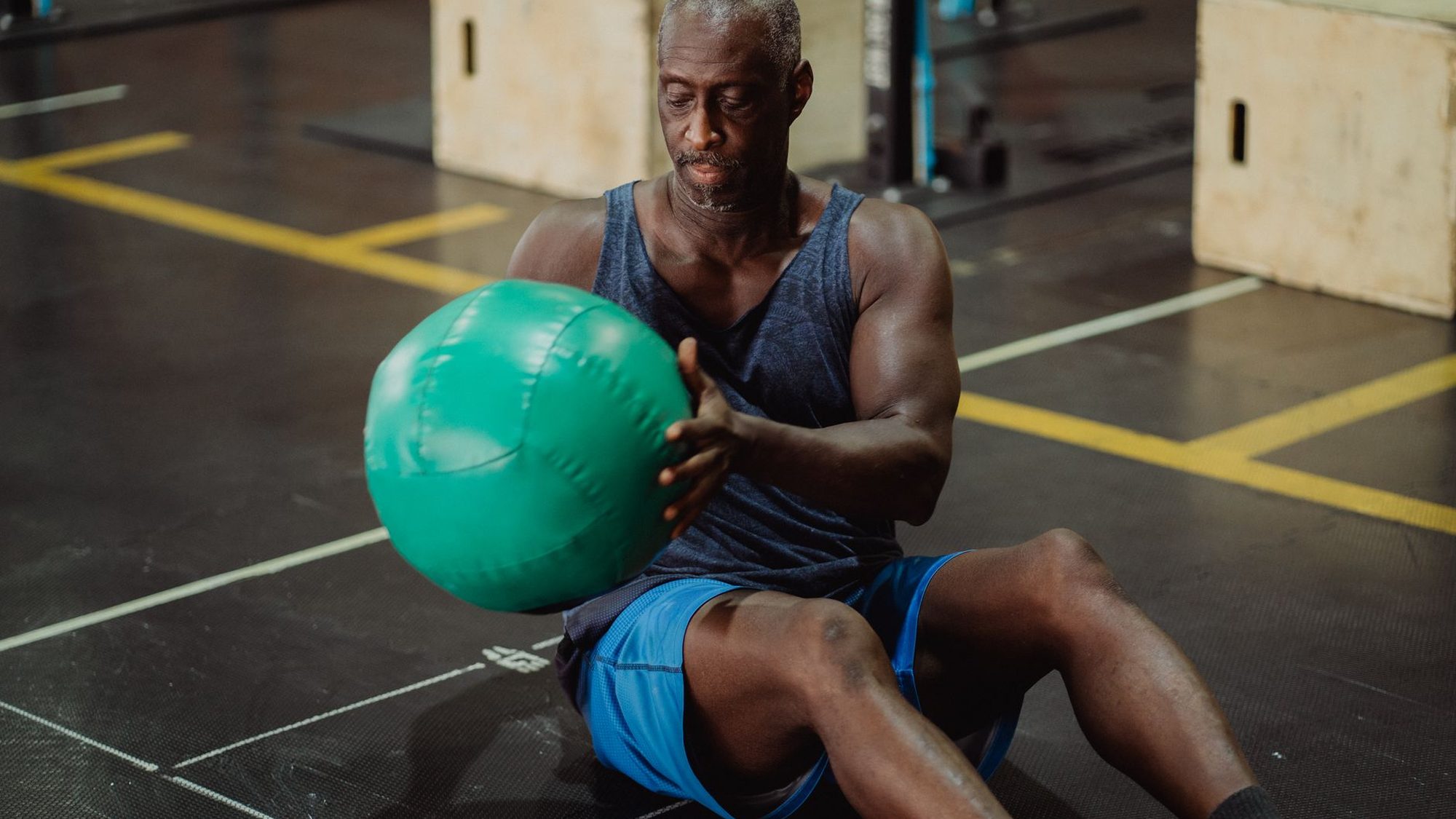
Training planning from 50: how to get started safely and effectively
From 50 onwards, the way your body responds to exercise changes: recovery takes longer, hormones shift, and muscles build more slowly. With the right planning, this is not an obstacle — it's a question of adaptation.
What changes from 50 — and what doesn't
From around age 50, age-related muscle loss (sarcopenia) accelerates, maximum heart rate decreases, connective tissue needs longer to recover, and hormone levels — especially testosterone and oestrogen — change noticeably. That sounds sobering, but it's only half the picture.
What doesn't change: the body's adaptability. The muscular and cardiovascular systems respond reliably to targeted training even after 50, 60 or 70. Studies show that people who start strength training in their sixth decade of life achieve similar relative strength gains within 12 weeks to younger beginners. The body ages — but it doesn't stop learning.
The four building blocks for 50+
The American College of Sports Medicine and the American Heart Association recommend a mix of four types of training for older adults: strength (at least 2×/week), endurance (at least 150 minutes moderate or 75 minutes vigorous per week), balance (at least 2×/week) and flexibility (at least 2×/week). This mix is not a wish list but a minimum for maintaining basic function.
Those who are not yet training regularly should not start everything at once. A sensible approach: in the first four weeks, focus exclusively on endurance (brisk walking or light cycling, 3×30 minutes), then gradually add strength sessions. Balance exercises can be incorporated from the start, as they require no fitness level.
Recovery: the underestimated key to success
As we age, the body needs more time to recover from training stimulus. While a 30-year-old may be fully ready again the next day after a hard session, the same session at 55 may require 48 to 72 hours of recovery. Ignoring this leads to overload — not because of weakness, but because of not adapting to the changed recovery windows.
In practice this means: strength training on alternating days at most, intense sessions no more than twice a week, and at least one full rest day per week. Light movement (walking, swimming, yoga) often speeds up recovery better than complete rest, because it promotes circulation.
Periodisation: why rest periods are part of the plan
Professional athletes have known about periodisation for decades — the deliberate alternation of high-load and lower-load weeks. For beginners and those returning to exercise from 50, it is especially important: after three weeks of increasing training volume, a lighter week follows in which the body consolidates the adaptations made.
A simple scheme: week 1 (easy, learn technique) → week 2 (moderate, increase volume) → week 3 (a bit harder, raise intensity) → week 4 (deload: reduce volume to 60%). This four-week pattern can be repeated indefinitely. Those who stick to it consistently make more progress over a year than someone training without structure.
Structuring your training plan in the YUTHI app
The key is consistency, not intensity. Three moderate sessions per week, every week, over a year — that beats any two-month intensive block. If you are starting fresh or returning after a break, begin with what you can do safely and without pain, and first increase volume, then intensity.
In the YUTHI app you can structure your training, log sessions and track how your strength, endurance and general wellbeing develop over months. This helps you see whether you are on track — and when a deload week is overdue.
That was the snapshot. The app turns it into daily support.
Measure every day instead of calculating once: Vito or Vita puts your numbers in context, builds you a weekly plan and speaks up when something stands out.
Launching at the end of 2026 — iPhone first, Android to follow. Let me know when it’s out ↓
Sources
- Fragala MS, Cadore EL, Dorgo S, et al. Resistance Training for Older Adults: Position Statement From the National Strength and Conditioning Association. J Strength Cond Res. 2019;33(8):2019–2052.
- Nelson ME, Rejeski WJ, Blair SN, et al. Physical activity and public health in older adults: recommendation from the American College of Sports Medicine and the American Heart Association. Med Sci Sports Exerc. 2007;39(8):1435–1445.
- Cadore EL, Pinto RS, Bottaro M, Izquierdo M. Strength and endurance training prescription in healthy and frail elderly. Aging Dis. 2014;5(3):183–195.