
Balance and fall prevention: The underrated longevity exercise
Falls are the most common cause of injury-related mortality in people aged 65 and over. The good news: balance is trainable — and just a few weeks of regular exercises measurably reduces fall risk.
Why balance is more than a gymnastic exercise
When people think about longevity, they think about heart health, muscle mass or biomarkers. Balance is rarely the first thing that comes to mind. Yet the statistics show: falls are the most common cause of injury-related deaths in people over 65, even ahead of car accidents. In Switzerland, around 80,000 people over 65 suffer a fall requiring medical treatment every year.
A fall is rarely just a fall. Hip fractures following a fall are associated with significant subsequent mortality — up to a quarter of those affected die within a year from the consequences. Balance training is therefore not a footnote, but one of the most effective longevity interventions of all.
How balance works — and why it declines with age
Your balance system consists of three sources: the vestibular organ in the inner ear, vision, and proprioception — the body sense that muscles, tendons and joints feed back to you. With age, each of these sources gradually deteriorates: vestibular function declines, visual processing slows down, and nerve conduction in the legs becomes less responsive.
On top of this comes sarcopenia, the age-related loss of muscle mass: those with less muscle mass in their legs respond more slowly to unexpected swaying. Balance is an interplay of strength, reaction time and neural processing. All three components can be trained.
What the evidence shows
The evidence for targeted balance training is compelling. A Cochrane review (Gillespie et al., 2012) evaluated over 150 controlled studies and showed that exercise programmes combining balance and strength reduce fall risk by 20 to 40%. The effect is dose-dependent: at least two hours of training per week over several months are needed to achieve a measurable effect.
Tai Chi and proprioceptive training are particularly well studied. A meta-analysis by Okubo and colleagues (Br J Sports Med, 2017) showed that step reaction training — the targeted practice of quick corrective steps — improves reaction time, gait and balance, and significantly reduces fall rates in controlled studies.
Simple tests and starter exercises
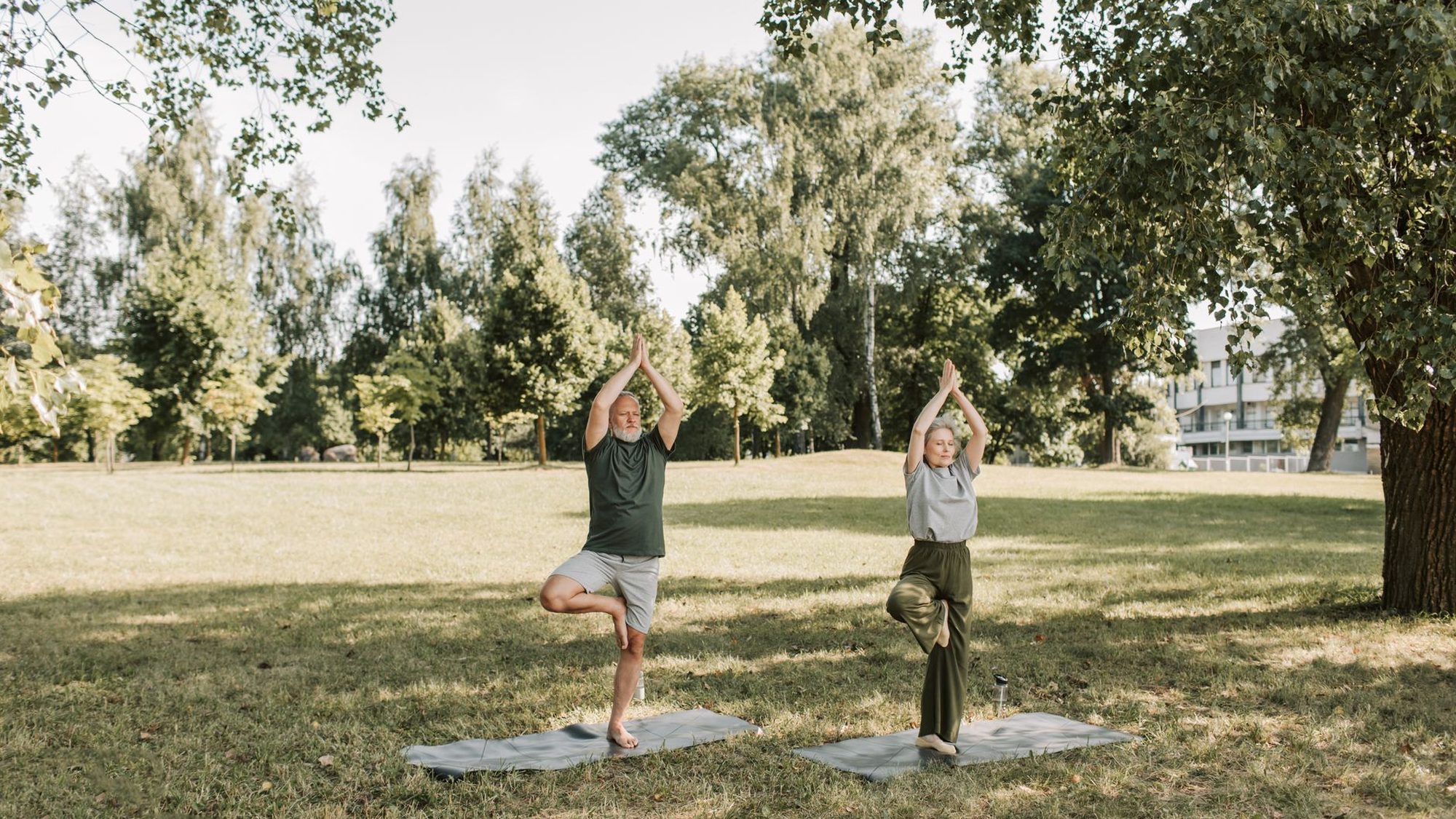
A simple self-test is the single-leg stand: stand on one leg, arms loosely at your side, and measure the time. Under 10 seconds with eyes open is considered an indicator of increased fall risk from age 60 onwards. The test is not a medical diagnosis, but gives you a baseline.
Introductory exercises you can start right away: single-leg stand at a chair back (daily, 3 × 30 seconds per side), tandem walk (heel to toe, 10 steps in a straight line), and standing up from a chair without using your arms — the so-called chair-rise test, which challenges leg extensors and balance at the same time. More advanced users can perform the same exercises on a soft surface or with eyes closed.
Balance as a daily habit — track it with the YUTHI app
Balance training is one of the few interventions that fits into any daily routine without needing extra time: brush your teeth standing on one leg, stand on one leg while waiting for the bus, climb stairs mindfully and without holding the railing. Small doses, repeated daily, work reliably.
In the YUTHI app you can log your balance exercises and strength training sessions and see whether you are reaching the recommended two hours per week. Combined with your other activity data, you can tell which building blocks of your training are already strong — and where gaps remain.
That was the snapshot. The app turns it into daily support.
Measure every day instead of calculating once: Vito or Vita puts your numbers in context, builds you a weekly plan and speaks up when something stands out.
Launching at the end of 2026 — iPhone first, Android to follow. Let me know when it’s out ↓
Sources
- Gillespie LD, Robertson MC, Gillespie WJ, et al. Interventions for preventing falls in older people living in the community. Cochrane Database Syst Rev. 2012;(9):CD007146.
- Okubo Y, Schoene D, Lord SR. Step training improves reaction time, gait and balance and reduces falls in older people: a systematic review and meta-analysis. Br J Sports Med. 2017;51(7):586–593.
- Sherrington C, Whitney JC, Lord SR, et al. Effective exercise for the prevention of falls: a systematic review and meta-analysis. J Am Geriatr Soc. 2008;56(12):2234–2243.