
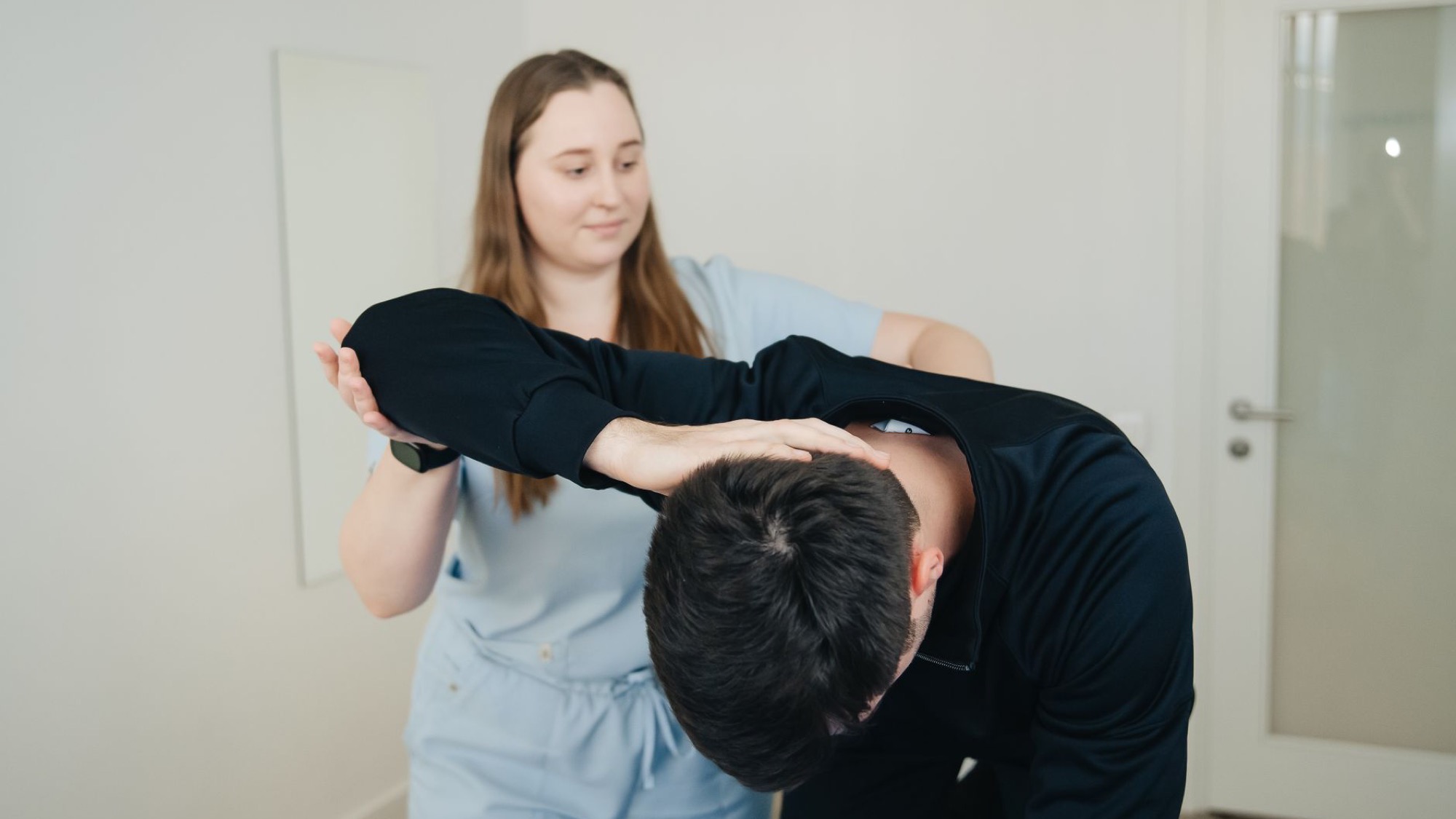
Back pain: movement instead of rest
The old recommendation was bed rest. Today the opposite is standard — and movement is the only measure with an established preventive effect. What type, how much, and why an MRI rarely helps.
What lies behind most back pain
In around ninety percent of cases of back pain, no clear physical cause is found. The medical term for this is non-specific low back pain. That may sound like a dead end, but it is actually good news: it means no structure has been damaged that would need to be repaired.
Imaging often misleads here. Disc bulges, signs of wear and tears in the annulus fibrosus are found in people with no symptoms at all — and more frequently the older they are. Among forty-year-olds with no back pain, more than half show such findings on MRI. A scan alone therefore rarely explains the pain, but it often creates fear of movement.
Why rest prolongs the problem
Bed rest was considered a treatment for decades. The Lancet review by Foster and colleagues from 2018 puts that to rest: prolonged avoidance of activity delays recovery, weakens the muscles and amplifies fear of loading. The current recommendation is to stay active and resume everyday activities as soon as possible.
Behind this lies a cycle that pain researchers can describe clearly: pain leads to rest, rest leads to loss of strength and increased sensitivity, which leads to more pain under less load. Anyone who wants to break this cycle has to start with movement — not with rest.
What the studies say about exercise
The Cochrane review by Hayden and colleagues from 2021 analysed studies involving over twenty thousand people with chronic low back pain. Exercise therapy reduced pain and improved function compared to no treatment or usual care. The effects are moderate, but consistent.
For prevention, movement is even the only thing with proven efficacy. Steffens and colleagues examined in 2016 which measures prevent new episodes of back pain: exercise reduced the risk by around thirty-five percent, exercise combined with education by almost half. Back braces, insoles and individual ergonomic measures showed no demonstrable benefit.
What type of exercise
Perhaps the most important finding: the type matters less than expected. Searle and colleagues compared various approaches in 2015 — strength training, stabilisation exercises, endurance, Pilates, yoga, aqua gymnastics. All were effective, and no single type was clearly superior to the others. What mattered was that training happened at all, and regularly.
This leads to a practical rule: choose what you can stick with. If you like strength training, do strength training — squats, deadlifts and rows with clean technique and moderate weight are not a risk to the back, they are training for it. If you prefer swimming or yoga, do that. Two to three sessions per week over at least twelve weeks is the scale on which the studies operate.
Warning signs that require something else
There are signs where the right step is investigation, not exercise. These include: numbness in the saddle area, disturbance of bladder or bowel function, progressive paralysis or loss of strength in the leg, severe night pain without relief from changing position, fever, unintentional weight loss, pain following a fall or accident, and a history of cancer.
These signs are rare, but they are the reason you should know them. If they apply, the matter belongs in medical hands promptly. For everyone else: movement is the treatment, not the risk. This content does not replace medical advice or a physiotherapy assessment.
How the YUTHI app helps you
Back pain fluctuates, and this up and down distorts memory — after a bad week, everything seems worse than it was. In the app you record pain intensity and exercise sessions side by side. Over twelve weeks a trend line emerges that tells you more than any single day's feeling.
Vito and Vita use exactly that when motivation is low. When your data show that pain is lower in weeks with two training sessions than in weeks without, that is an argument from your own history — and it carries further than any general recommendation. For the warning signs above, they advise clearly on seeking medical assessment rather than suggesting a programme.
That was the snapshot. The app turns it into daily support.
Measure every day instead of calculating once: Vito or Vita puts your numbers in context, builds you a weekly plan and speaks up when something stands out.
Launching at the end of 2026 — iPhone first, Android to follow. Let me know when it’s out ↓
Sources
- Foster NE, Anema JR, Cherkin D, et al. Prevention and treatment of low back pain: evidence, challenges, and promising directions. Lancet. 2018;391(10137):2368–2383.
- Hayden JA, Ellis J, Ogilvie R, Malmivaara A, van Tulder MW. Exercise therapy for chronic low back pain. Cochrane Database Syst Rev. 2021;9(9):CD009790.
- Steffens D, Maher CG, Pereira LSM, et al. Prevention of Low Back Pain: A Systematic Review and Meta-analysis. JAMA Intern Med. 2016;176(2):199–208.
- Searle A, Spink M, Ho A, Chuter V. Exercise interventions for the treatment of chronic low back pain: a systematic review and meta-analysis of randomised controlled trials. Clin Rehabil. 2015;29(12):1155–1167.