
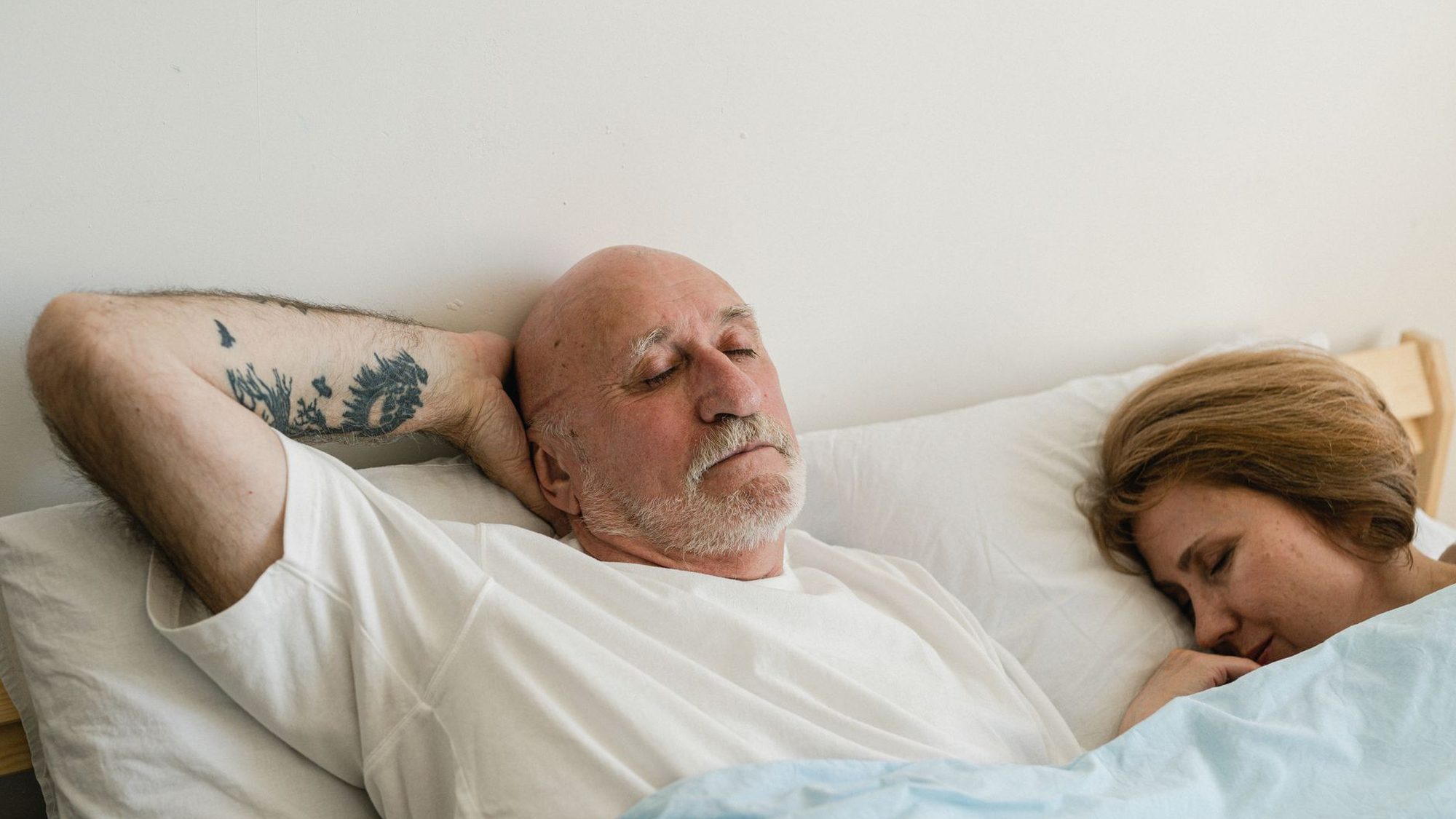
Sleep as you age: why you sleep differently than at 25
Sleep changes fundamentally as we get older — and there are biological reasons for it. Knowing what is normal and what could be treated helps you take targeted action, rather than accepting sleep problems as inevitable.
What changes about sleep as you age
Sleep is not a constant across the lifespan. Ohayon et al. (Sleep, 2004) analysed sleep parameters from childhood to old age across over 65 studies in a meta-analysis. The results show clear patterns: with increasing age, the proportion of deep sleep (slow-wave sleep) decreases, REM sleep duration shortens, total sleep duration declines slightly, and sleep onset latency increases.
At the same time, chronotype shifts with age: while teenagers and young adults are often pronounced evening types, people around 50 and older tend to feel tired earlier and wake up earlier. This is not imagination — it is a biologically driven shift of the internal clock.
The loss of deep sleep and its consequences
The decline in deep sleep is particularly striking. Mander, Winer and Walker (Neuron, 2017) described how slow-wave sleep begins to decrease in middle adulthood and by old age falls to a fraction of its youthful value. Deep sleep is the phase during which growth hormone is released, tissue repair takes place and memories are consolidated.
Less deep sleep means: less HGH, slower recovery, poorer memory consolidation. Van Cauter et al. (JAMA, 2000) showed in a longitudinal study in men how growth hormone secretion steadily declined alongside the reduction in deep sleep — a connection that is especially relevant in the longevity field.
What is normal — and what is a sign of a problem
Not everything that changes in sleep with age requires treatment. Less deep sleep, more frequent brief awakenings, and a shift toward being an early riser are normal age-related changes. If you wake up feeling rested in the morning and function well during the day, there is no clinical problem.
What does require treatment, however: persistent daytime sleepiness despite sufficient sleep time, snoring or breathing pauses (signs of sleep apnea, which becomes more common with age), restless feelings in the legs in the evening (restless legs syndrome), or regularly waking up with a racing heart and anxiety. These symptoms are not part of normal age-related sleep and should be evaluated.
What can help against deep sleep loss
The good news: some factors that accelerate or intensify age-related sleep changes can be influenced. Physical activity — particularly endurance and strength training — demonstrably improves deep sleep quality. Consistent sleep times, little alcohol, and a cool sleeping environment also help to optimize the remaining deep sleep.
What helps little, on the other hand: spending more time in bed hoping to force more deep sleep. This often leads to more fragmented sleep. Quality over quantity applies here more than in younger years.
Sleep medication in older age: special caution
Benzodiazepines and Z-drugs (zolpidem, zopiclone) are associated with increased risks in older people: daytime sleepiness, cognitive impairment, increased risk of falls, and paradoxical agitation. The American Geriatrics Society explicitly lists these substances in their Beers List — that is, as potentially inappropriate medications for older adults.
When sleep problems in older age require treatment, CBT-I (Cognitive Behavioral Therapy for Insomnia) is also effective in this age group and carries none of the risks of pharmacotherapy. Consulting a sleep medicine specialist can help distinguish normal age-related changes from treatable sleep disorders.
How the YUTHI app helps you
When you track your sleep over time, you can see which changes are creeping in — and which ones can be influenced by targeted measures. The YUTHI app helps you connect exercise, sleep times, and sleep quality, and makes the effect of age-appropriate adjustments — such as earlier bedtimes or more consistent sleep hygiene — visible over weeks and months.
That was the snapshot. The app turns it into daily support.
Measure every day instead of calculating once: Vito or Vita puts your numbers in context, builds you a weekly plan and speaks up when something stands out.
Launching at the end of 2026 — iPhone first, Android to follow. Let me know when it’s out ↓
Sources
- Ohayon MM, Carskadon MA, Guilleminault C, Vitiello MV. Meta-analysis of quantitative sleep parameters from childhood to old age in healthy individuals. Sleep. 2004;27(7):1255–1273.
- Mander BA, Winer JR, Walker MP. Sleep and human aging. Neuron. 2017;94(1):19–36.
- Van Cauter E, Leproult R, Plat L. Age-related changes in slow wave sleep and REM sleep and relationship with growth hormone and cortisol levels in healthy men. JAMA. 2000;284(7):861–868.