
Grounding & Earthing: What Research Shows About Earth Contact
Barefoot on the lawn, earthing mats in bed — grounding promises to reduce inflammation and improve sleep. What's behind it, and what do the available studies actually say?
The idea behind grounding
Grounding — also called earthing — is based on the idea that the Earth's surface carries an electrical potential: it is saturated with free electrons that are said to transfer to the body through direct skin-to-earth contact. Proponents of the method see this as a way to reduce oxidative stress, because free electrons in the body could act as antioxidants.
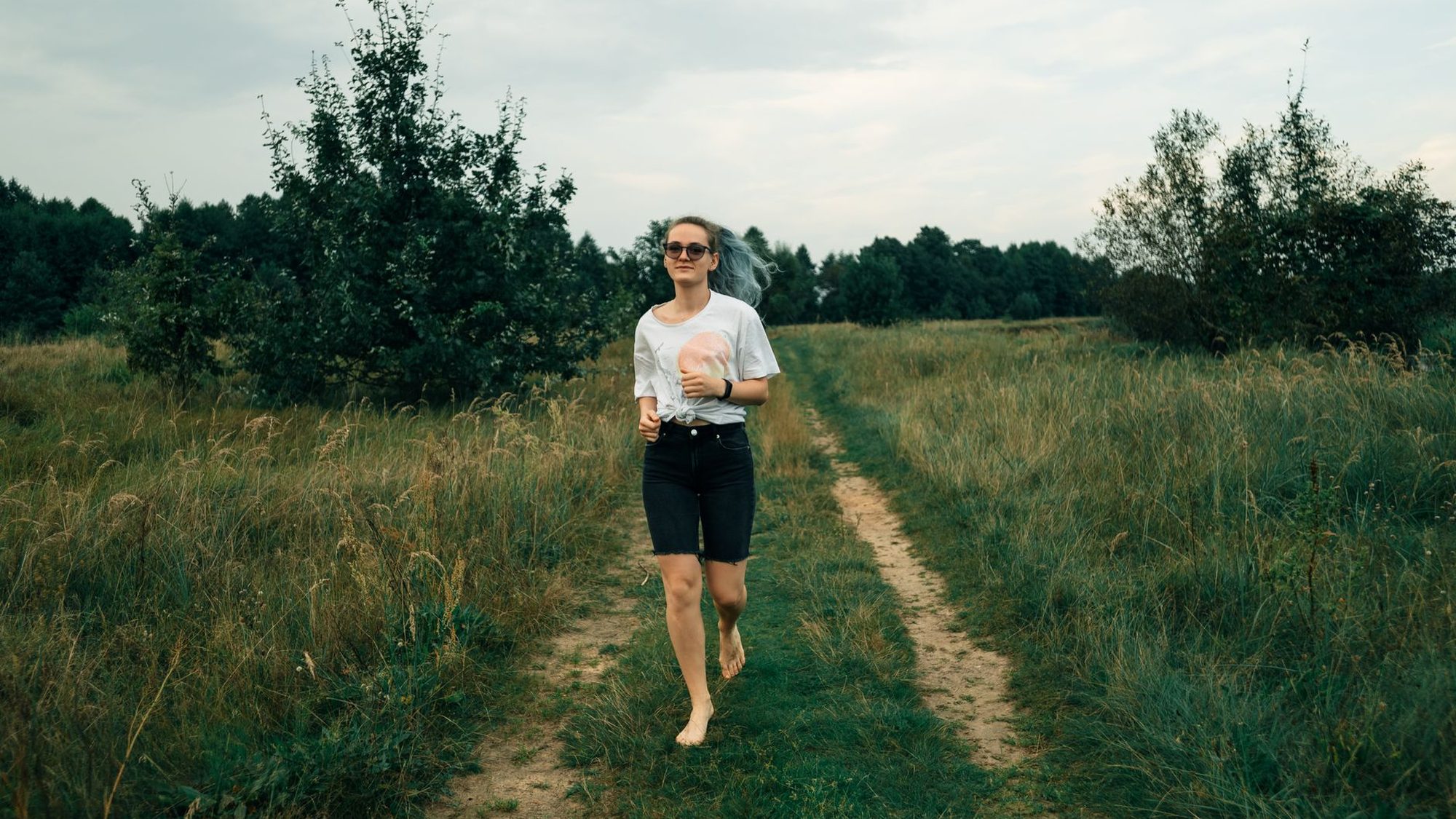
The most common approach is walking barefoot on grass, soil or sand. There are also conductive sleep mats and floor pads that connect via a protective cable adapter to the earth terminal of a socket, simulating earth contact.
What studies show
The best-known research group on this topic is Gaétan Chevalier. Chevalier and colleagues published several papers in which earthing mats showed changes in sleep, cortisol curves and inflammation markers in participants. A 2004 pilot study reported that participants who slept grounded described a normalised daily cortisol rhythm and subjectively better sleep after six weeks.
A review article in the Journal of Inflammation Research suggested that earth contact could increase the zeta potential of red blood cells and thereby improve microcirculation.
However, the quality of these studies must be viewed critically: most have small sample sizes, no or inadequate blinding, and many come from a tight network of interconnected authors. A robust, independently replicated randomised trial is still lacking.
Inflammation markers and sleep: What can be measured
In a placebo-controlled study, changes in the blood were documented using darkfield microscopy; the grounding group showed altered erythrocyte aggregation. These images are not standardised and difficult to compare with conventional laboratory values.
Grounding has rarely been studied with objective sleep measurement — i.e. via polysomnography. Most sleep claims are based on self-reports. This does not rule out real effects, but it does not make them scientifically proven. Anyone trying grounding should view it as a personal self-experiment, not a clinical treatment.
Grounding in everyday life: When and how
If you want to try grounding, walking barefoot on grass or at the beach is the simplest and free option. 20 to 30 minutes daily is the benchmark in most protocols. Moist ground conducts electrical charge better than dry ground; concrete and asphalt conduct barely at all.
Earthing mats from the internet vary greatly in quality and conductivity. If you use one, check whether the protective earth in your socket is correctly grounded — a standard extension lead is not sufficient for this. Without real earth contact, the mat is useless.
Logging grounding in the YUTHI app
Record your grounding sessions in the YUTHI app as a daily activity. Combine this with the app's sleep tracking, which logs sleep onset time, sleep duration and wake phases. If you notice no difference after three to four weeks, that is valid information — just as a positive effect would be.
For a cleaner self-assessment, you can additionally have an hsCRP value measured before and after four weeks and note the result in your profile. Self-observation is a legitimate starting point — even if it is not clinical evidence.
That was the snapshot. The app turns it into daily support.
Measure every day instead of calculating once: Vito or Vita puts your numbers in context, builds you a weekly plan and speaks up when something stands out.
Launching at the end of 2026 — iPhone first, Android to follow. Let me know when it’s out ↓
Sources
- Chevalier G et al. Earthing: health implications of reconnecting the human body to the Earth's surface electrons. Journal of Environmental and Public Health, 2012.
- Oschman JL et al. The effects of grounding on inflammation, the immune response, wound healing, and prevention of chronic inflammatory diseases. Journal of Inflammation Research, 8:83–96, 2015.
- Sokal K, Sokal P. Earthing the human body influences physiologic processes. Journal of Alternative and Complementary Medicine, 17(4):301–308, 2011.