YUTHI
All areas · Daily

Sleep

Your nights arrive by themselves. YUTHI calculates how regular your sleep is — and after a short night, searches your entries for what's behind it.

Soon on theApp Store Soon onGoogle Play

Try it free now · Not ready yet? Let me know.

The Sleep area in the app: last night 8.2 hours of an 8.0-hour need, fell asleep 22:29, woke up 06:40, streak of 28 nights, regularity 98% from Apple Health
The Cortisol page: daily curve as a schema with its peak 36 minutes after getting up and the day's entries as points — training and caffeine
What YUTHI keeps an eye on for you

More than counting hours: YUTHI asks why.

The app calculates three things from your nights and your day — the sources are listed at the bottom of the page.

How regular your sleep is

In a study of more than 60 000 people, regularity predicted mortality risk better than sleep duration — a connection, not a cause.5 The app calculates it for you as a percentage.

  • Steady week97%
  • Restless week71%
  • 21222301

Each dot is a time you fell asleep. The app combines falling asleep and getting up: 100% would mean the same time every night; each hour of average deviation costs about 33 points.
The sleep detective

If a night was shorter than you need, the app first searches the hours before for the cause itself. Only if it finds nothing does it ask you.

What the detective checks

  • Caffeinefrom 30 mg · 6 h before
  • Late mealfrom 200 kcal · 2 h before
  • Intense trainingup to 3 h before
  • Lots to drinkfrom 400 ml · 90 min before
  • Stressfrom 7 of 10
  • Little daylightbelow half your goal

Little daylight only counts if you usually log sun. Plus alcohol in the 8 hours before sleep and going to bed at least an hour later than usual. Then it compares: “On evenings with afternoon caffeine you sleep … minutes less on average.” If it finds nothing, it asks about your phone in bed, a room that's too warm or noise.

Your cortisol rhythm

Cortisol rises clearly in the first 30 to 45 minutes after waking and then falls over the day.8 The app aligns the curve with the time you get up.

  • Peak · 36 min after getting up at 06:30
  • Your entries · morning light, coffee, training

The curve is a schema, not a measurement. The points don't change it — they only show what happened in your day. If you have a cortisol blood value, it appears next to it.

What else you can do with it

Sleep better without guessing.

Your evening by the clock

From your bedtime, the app calculates when a warm shower fits and when your last coffee should be. In an analysis of 17 studies, a warm shower or bath 1 to 2 hours before sleep shortened the time to fall asleep.6

  • Warm showerBed at 11 pm on average · 1 to 2 hours before9–10 pm
  • Last coffee6 hours before bed7by 5 pm

Evening exercise doesn't harm sleep on average — only very intense training in the last hour before bed can delay falling asleep.11

Your nights arrive by themselves

With a watch and Apple Health or with Oura, every night lands in the app in the morning, sleep stages included. YUTHI never overwrites what you log by hand.

  1. Watch or ring at night
  2. Apple Health or Oura
  3. In YUTHI in the morning

Wrist devices detect sleep well, but individual stages only roughly — look at the trend, not a single night.9

How much you need

An expert panel recommends 7 to 9 hours for adults and 7 to 8 for older adults.4 The app compares your average with your need and tells you how many minutes earlier you could go to bed.

One bad night is normal. A series of them shows a pattern — that's why the average over weeks counts.

Shift work too

If you work shifts, the app tells you honestly: the US sleep medicine guideline only gives conditional recommendations here, and the evidence is often thin.

  1. Early
  2. Late
  3. Night

A clockwise shift order is better than the reverse. Bright light during the night shift and caffeine before or during the shift can help against tiredness — but not shortly before sleep.10

A look inside the app

Every night, stage by stage.

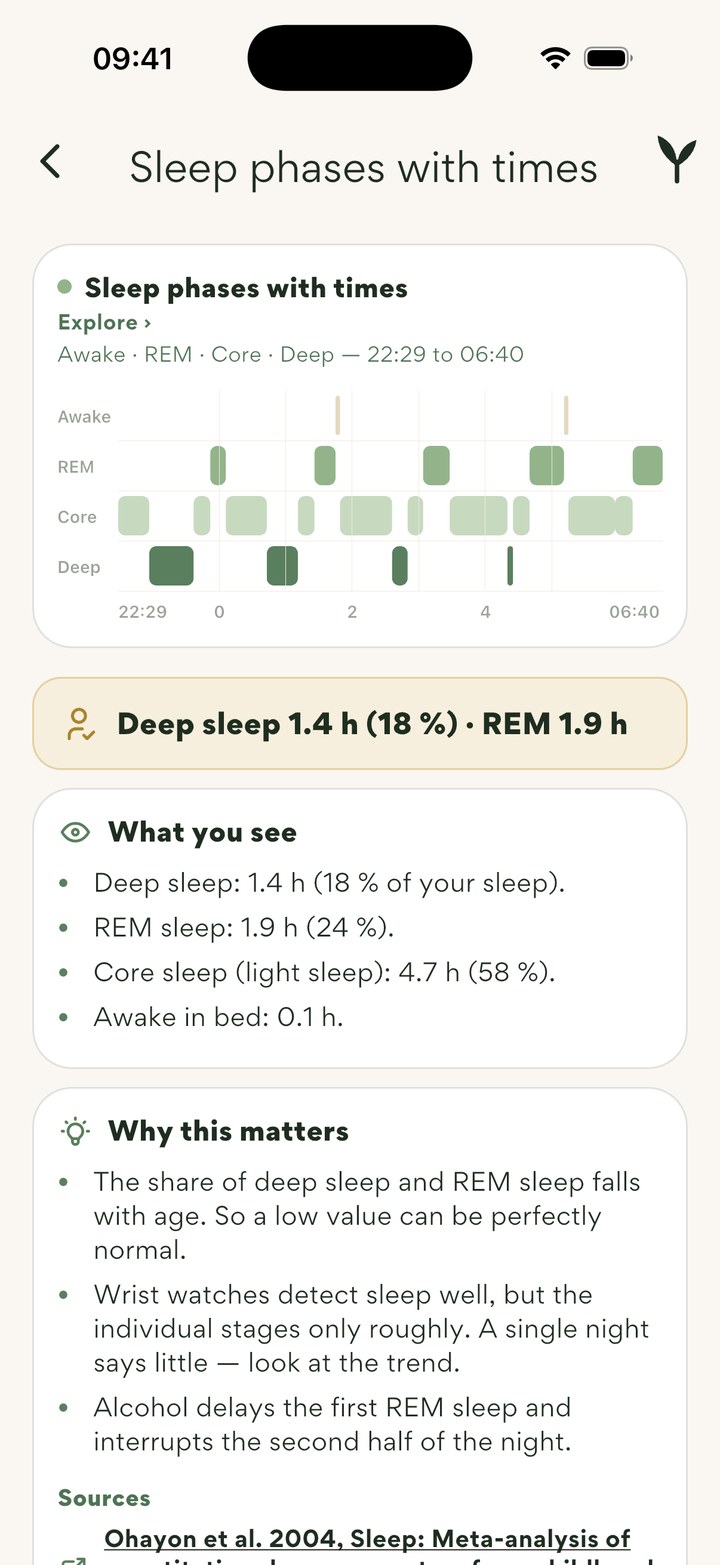
With a watch, you see when you were in deep, core and REM sleep. The analysis puts your week, rhythm and average side by side.

Sleep stages of one night from 22:29 to 06:40: deep sleep 1.4 hours (18%), REM sleep 1.9 hours (24%), core sleep 4.7 hours (58%)
Sleep stages by the clock
The Analysis tab in the Sleep area: week, rhythm with 98% regularity, average, sleep stages, cortisol and four weeks
The analysis
Your areas talk to each other

Sleep is connected to more than you think.

The app already calculates these connections today. A connection is not a cause — but it shows you where to look.

What does your body good

Regular times

In a study of about 61,000 people (UK Biobank, movement sensors), a regular sleep-wake rhythm was linked to a 20 to 48 % lower risk of death. It predicted risk better than sleep duration. That is an association, not proof of a cause.1

A warm shower in the evening

In a review of studies, a warm shower or bath (40 to 42.5 °C) about one to two hours before bed shortened the time it took to fall asleep.2

A cool bedroom

Heat makes sleep more restless and shortens deep sleep and REM sleep. Air the room before bed and cover up so that you are neither hot nor cold.3

What you should rather skip

Caffeine in the afternoon and evening

400 mg of caffeine taken six hours before bed measurably shortened sleep time in one study. Remember cola, black tea and green tea, too.4

Alcohol in the evening

Alcohol makes you sleepy faster but disturbs the second half of the night: sleep becomes more restless and the first REM sleep comes later.5

Bright screens before sleep

People who read on a light-emitting device in the evening fell asleep later, had less melatonin and were less alert the next morning than with a printed book.6

Nicotine and very hard training right before bed

Nicotine lengthens the time to fall asleep and fragments sleep. Evening exercise does not harm sleep in studies; only very intense training that ends less than an hour before bedtime can affect falling asleep and sleep duration.78

More in the magazine

A new article every Friday.

All articles in the magazine
Sources
  1. Windred DP et al.: Sleep regularity is a stronger predictor of mortality risk than sleep duration: A prospective cohort study. Sleep 2024
  2. Haghayegh S et al.: Before-bedtime passive body heating by warm shower or bath to improve sleep: A systematic review and meta-analysis. Sleep Med Rev 2019
  3. Okamoto-Mizuno K et al.: Effects of thermal environment on sleep and circadian rhythm. J Physiol Anthropol 2012
  4. Drake C et al.: Caffeine effects on sleep taken 0, 3, or 6 hours before going to bed. J Clin Sleep Med 2013
  5. Ebrahim IO et al.: Alcohol and sleep I: effects on normal sleep. Alcohol Clin Exp Res 2013
  6. Chang AM et al.: Evening use of light-emitting eReaders negatively affects sleep, circadian timing, and next-morning alertness. Proc Natl Acad Sci U S A 2015
  7. Jaehne A et al.: Effects of nicotine on sleep during consumption, withdrawal and replacement therapy. Sleep Med Rev 2009
  8. Stutz J et al.: Effects of Evening Exercise on Sleep in Healthy Participants: A Systematic Review and Meta-Analysis. Sports Med 2019
  9. Irish LA et al.: The role of sleep hygiene in promoting public health: A review of empirical evidence. Sleep Med Rev 2015
  10. Spiegel K et al.: Impact of sleep debt on metabolic and endocrine function. Lancet 1999
  11. Black DS et al.: Mindfulness meditation and improvement in sleep quality and daytime impairment among older adults with sleep disturbances: a randomized clinical trial. JAMA Intern Med 2015

Every statement comes with its source; the figures are taken from the linked studies and opinions (checked on 1 November 2026). This is context from the research, not a diagnosis and no substitute for medical advice.

Try it free now

Get YUTHI from the App Store — iPhone first, from November 2026.

Soon on theApp Store Soon onGoogle Play

Not ready yet? Let me know.