How your fluid goal is built
The base is your weight. Training, heat, sauna and creatine come on top — and in the app every line explains itself with a tap.
Your fluid goal adapts to your weight, training, heat and sauna. Tap a glass or bottle, YUTHI reminds you at the right time and shows how long your coffee keeps working.


Three examples of how the app calculates — every number comes from a study or scientific opinion listed below.
The base is your weight. Training, heat, sauna and creatine come on top — and in the app every line explains itself with a tap.
Everything you drink appears in your list. Not every drink counts towards your fluid goal, though.
The app draws a curve for every caffeinated drink. You see what is still in your blood at bedtime.
Calculated with a half-life of about 5 hours; in adults it ranges from 2 to 8 hours. Up to 400 mg a day is considered safe for healthy adults.2
It spreads your goal between getting up and going to sleep: small amounts instead of a few large ones, never more than 700 ml in one hour, and the last two hours before sleep stay free. If your goal rises on a hot day, it recalculates.
2.0 l7 reminders
Week, month and rhythm: see on which days you reach your goal and at what times you drink.
Example week · line = fluid goal · dark = goal reached
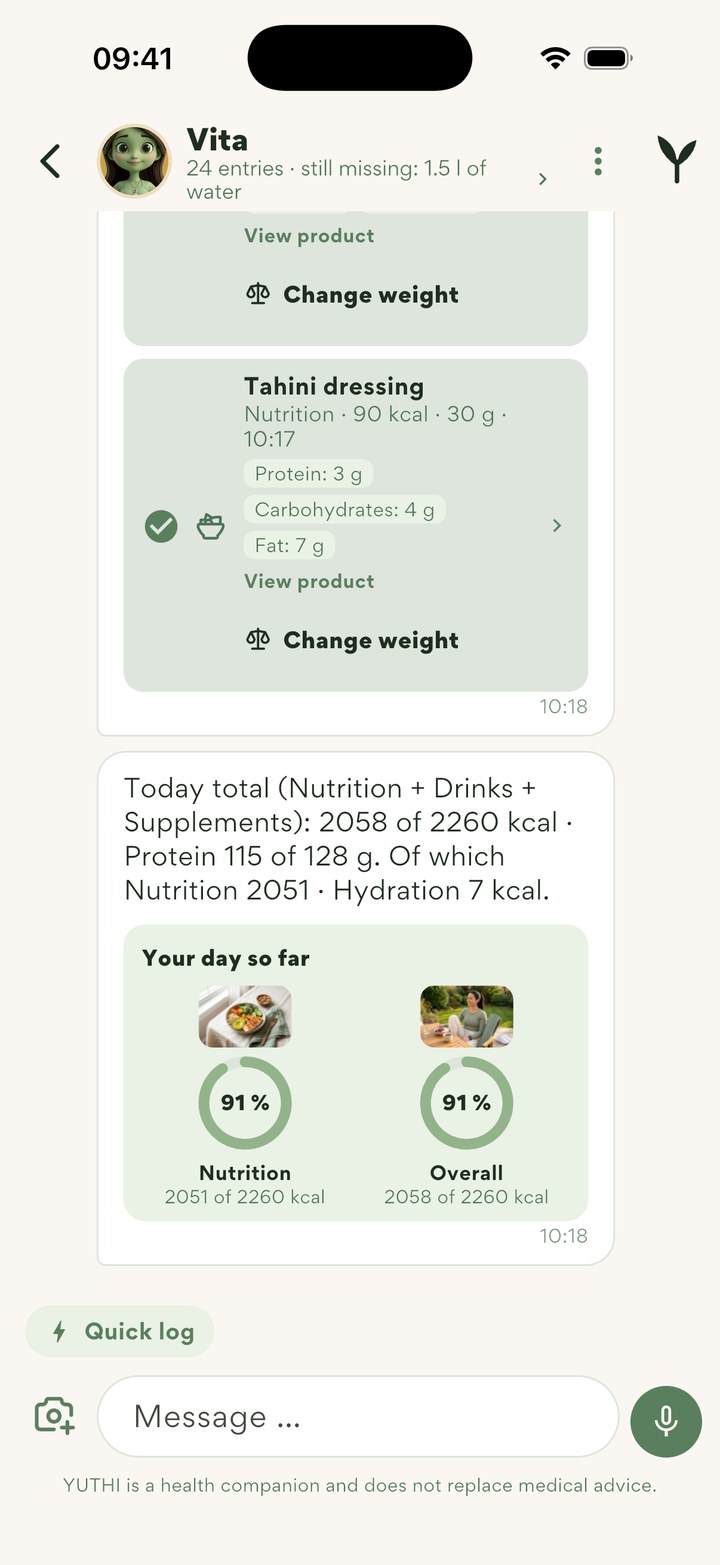
Juice, latte or beer bring energy. The app adds them up with nutrition and supplements into one daily total.
Example of one day
= 1980 kcal in total today
If you like, YUTHI writes your fluid intake back to Apple Health — so everything stays in one place.
The app already calculates these connections today. A connection is not a cause — but it shows you where to look.
Training raises your fluid goal by 0.4 to 0.8 litres per hour, depending on intensity. After ten shared days a scatter chart shows how both line up for you.
Water from food counts, and the calories of your drinks go into the same daily total.
If you take creatine, 0.4 litres are added: creatine draws water into the muscle cells.
One sauna round costs about half a litre of sweat — the app adds it to your goal.8
The sleep page calculates how many hours before bed your last caffeine was — and on how many days it was less than six.
Caffeine, training and morning light appear as points on your cortisol card.
If a blood value is off, the blood values page also gives you tips on drinking.
If you take L-thyroxine or fluvoxamine and drink coffee, the app shows a note — with the advice to discuss it with your doctor or pharmacy.
After quitting smoking your body breaks down caffeine more slowly. The app suggests drinking caffeine earlier in the day.
When your mood dips in the afternoon, the mood detective checks whether you'd drunk less than 35 % of your hydration goal by then.
The European Food Safety Authority (EFSA) considers 2.0 litres of water a day (women) and 2.5 litres (men) adequate for adults. That means everything together that you take in from drinks and from food.1
Up to 400 mg of caffeine a day is considered safe for healthy adults. That is roughly three to four cups of filter coffee.2
The WHO advises limiting free sugars to less than 10 % of daily energy. Less than 5 % may bring additional benefits. Free sugars include sugar that is added to drinks.3
In one study, even a dose of 400 mg of caffeine taken six hours before the usual bedtime had a measurable effect: total sleep time got shorter.4
A large analysis covering 195 countries found that the level of drinking with the smallest loss of health is zero drinks per week.5
If you take the thyroid hormone L-thyroxine: in one study about a third less hormone (29 to 36 %) reached the blood with coffee than with water. Coffee one hour later made no difference. Talk to your doctor or pharmacist about it.6
A new article every Friday.
 Nutrition · HydrationHow much water should you drink a day? Why the two-litre rule wasn't made for youTwo litres of water a day is treated as gospel. The research tells a different story: your needs depend on your body, activity and the weather; coffee and food count too, and drinking too much at once can actually be dangerous. Here's how to find your own personal benchmark.Read more
 Nutrition · StimulantsCaffeine: Performance, sleep, and what you should know about your cupCaffeine is the world's most widely consumed psychoactive substance — and one of the most thoroughly researched. What happens in your body after that first coffee, how long does caffeine last, and where is the limit?Read more
 Biohacking · Caffeine & ChronobiologyCaffeine timing: When you should drink coffee — and when you shouldn'tDrinking your first coffee right after waking up is a widespread habit — but possibly not the optimal one. What chronobiology says about caffeine, cortisol, and adenosine.Read more
Every statement comes with its source; the figures are taken from the linked studies and opinions (checked on 1 November 2026). This is context from the research, not a diagnosis and no substitute for medical advice.
Get YUTHI from the App Store — iPhone first, from November 2026.