YUTHI
All areas · Daily

Smoking cessation

Clean break or step by step. YUTHI shows you every day what you've already achieved — and a slip erases nothing.

Soon on theApp Store Soon onGoogle Play

Try it free now · Not ready yet? Let me know.

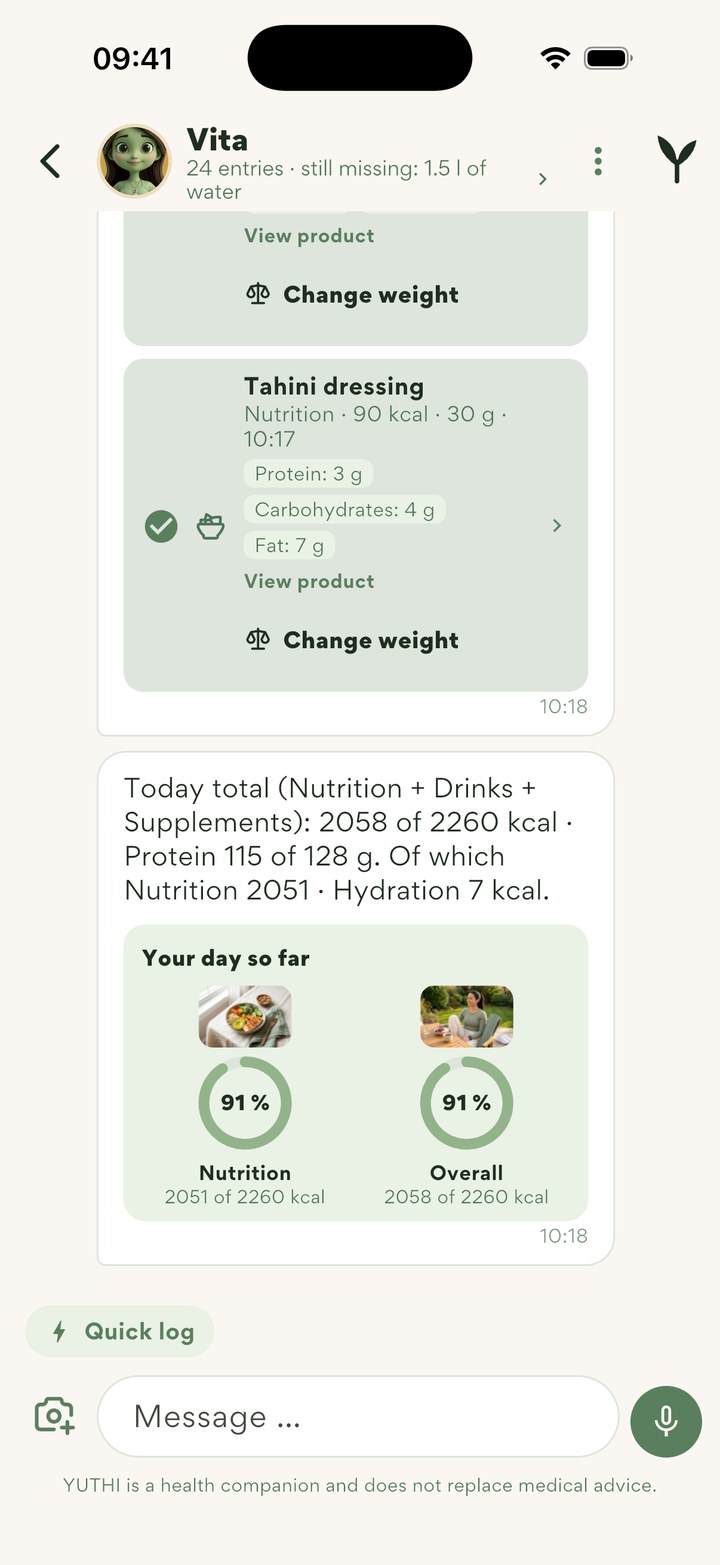
The Quit smoking area in the app: smoke-free for 28 days, CHF 201 saved, 424 cigarettes not smoked, 3 days of life, one slip subtracted but not reset
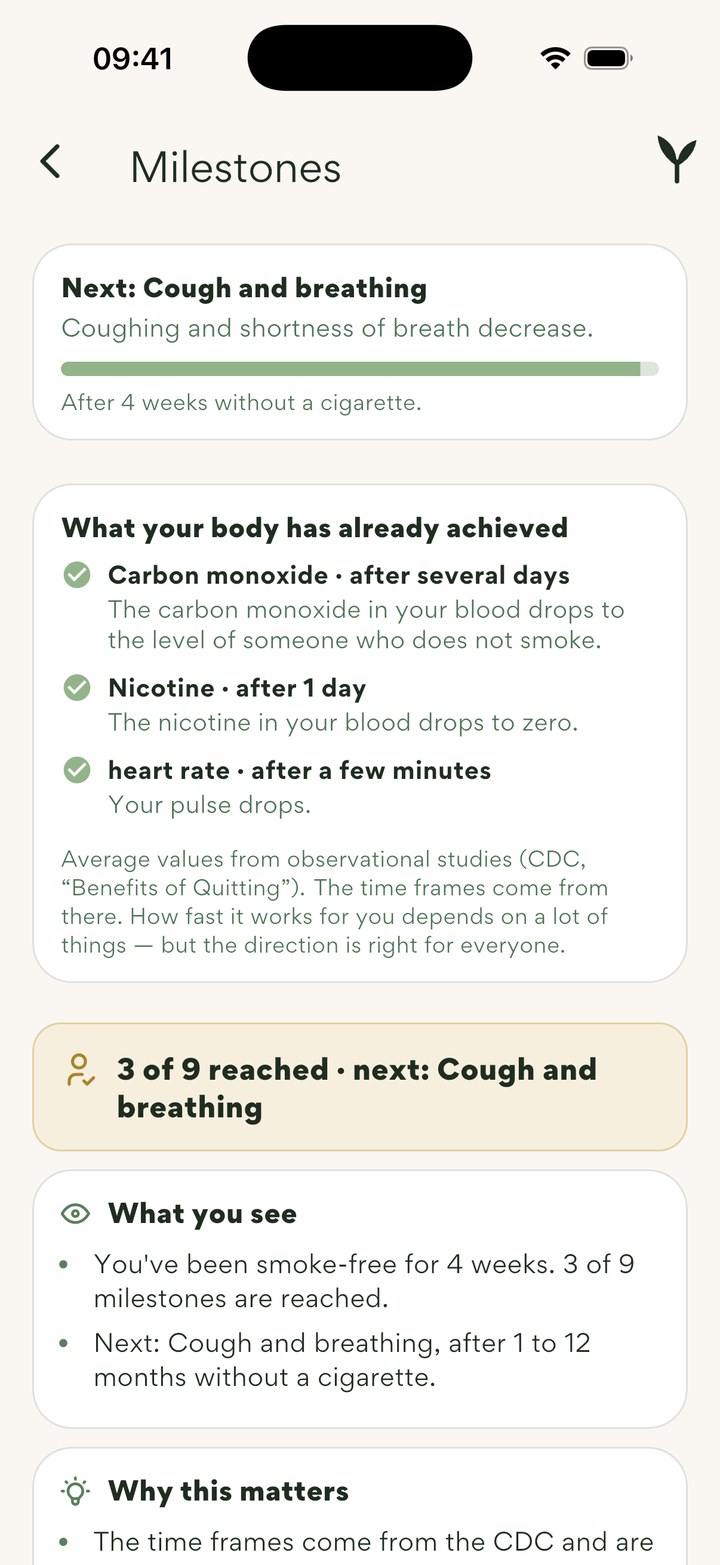
The Milestones page: next up cough and breathing; carbon monoxide, nicotine and pulse already reached, with the CDC as source
What YUTHI keeps an eye on for you

No counter that starts from zero: YUTHI counts what you've already achieved.

Three things the app calculates for you — the sources are listed at the bottom of the page.

What it costs you

Enter what you smoke and what a pack costs. The app adds up the money and the time of life. On average, one cigarette costs about 11 minutes of life.5

  • Per month15 a day · pack CHF 9.50 for 20CHF 217
  • Per year365 daysCHF 2601
  • Life per year15 × 365 × 11 minutesabout 42 days

In a large US study, people who quit before 35 gained back about 10 years of life, those between 45 and 54 about 6.6 Cigarettes, roll-ups, heated tobacco, e-cigarettes and cigars each get their own price.

Relapse without shame

Many counters jump back to zero after a single cigarette. YUTHI keeps counting: a slip is noted and subtracted, but it erases nothing.

Example: quit 4 weeks ago, 15 a day

  • Smoke-free for28 days
  • Not smoked · 1 slip subtracted424
  • Saved · plus about 3 days of lifeCHF 201

What counts is the direction. After a slip, you carry on from where you are.

What your body has already achieved

Nine milestones from the US health authority CDC — from your pulse after a few minutes to a heart that, after 15 years, is almost as healthy as that of someone who never smoked.4

  1. After minutesYour pulse drops.
  2. After 1 dayNicotine in the blood drops to zero.
  3. After daysCarbon monoxide drops to the level of a non-smoker.
  4. After 1–12 monthsCoughing and shortness of breath decrease.
  5. After 1–2 yearsThe risk of a heart attack drops sharply.
  6. After 3–6 yearsThe added risk of coronary heart disease is cut in half.
  7. After 5–10 yearsThe risk of stroke drops.
  8. After 10–15 yearsThe added risk of lung cancer is cut in half.
  9. After 15 yearsYour heart comes close to a non-smoker's.

Green: reached after 4 weeks. The times are averages from observational studies, not a guarantee — but the direction is the same for everyone.

What else you can do with it

Your way, your pace, your support.

Clean break or step by step

Both ways are possible. If you choose steps, you get a ladder built from your own starting point and stay on a step as long as you like. In a study of 697 smokers, 22 % were smoke-free after 6 months with a clean break and 15.5 % with the gradual approach — the app tells you honestly and lets you choose.7

Starting at 10
  1. 10
  2. 7
  3. 5
  4. 3
  5. 1
  6. 0
Starting at 30
  1. 30
  2. 26
  3. 21
  4. 15
  5. 9
  6. 3
  7. 0

The steps are 100, 70, 50, 30 and 10 % of your starting value. If you smoke 20 or more a day, you get a gentler first step at 85 %, so the first step is smaller.

When the craving comes

One tap on “Craving” notes the moment with its time and shows you a four-minute exercise.

  1. 1Breathe4 seconds in, 6 out, ten times
  2. 2Drinka glass of water, in small sips
  3. 3Get outstep outside or change rooms

Under “Help” you'll find free support lines for your country, in Switzerland for example the quitline 0848 000 181. Telephone counselling increases the chance of staying smoke-free.11

Your body burns a little less

When you quit, you use slightly less energy: in a measurement chamber, daily expenditure rose by 215 kcal with 24 cigarettes.8 From the day after you quit, the app subtracts this from your calorie goal — and shows how much walking makes up for it.

  • Less expenditure15 cigarettes × 215 ÷ 24 kcal134 kcal
  • Make up for it by walkingat 65 kg, 100 steps per minute62 min

That's about 6200 steps. On a day with a slip, the deduction doesn't apply. On average, people gain 4 to 5 kg in the first year after quitting — that's not failure.10

Caffeine lasts longer

After quitting, the body breaks caffeine down more slowly: in people who had smoked 20 or more a day, breakdown fell by 36 %.9 The app factors this into your caffeine curve.

  1. Quitting
  2. Breakdown −36 %
  3. Caffeine lasts about 1.6 times as long

So better earlier in the day. Something similar applies to medications — tell your doctor that you're quitting.

Your areas talk to each other

Quitting smoking is connected to more than you think.

The app already calculates these connections today. A connection is not a cause — but it shows you where to look.

What does your body good

Quitting pays off, even later

In a US study of about 200,000 adults, smokers' risk of death was about three times that of people who had never smoked. Those who quit before 40 cut the extra risk by about 90 %. Even those who quit at 45 to 54 gained about 6 years of life on average compared with continuing to smoke.1

Get help

Counselling and medication can more than double the chance of quitting successfully.2

Expect some weight gain

After quitting, most people gain some weight: on average about 1.1 kg in the first month and 4.7 kg after a year, most of it in the first three months. That is not failure. 16 % even lost weight.3

What you should rather skip

Trying to go it alone

The WHO names counselling and medication as what raises the chance of success the most. In the app you find counselling services right in the area.2

Nicotine in the evening

Nicotine lengthens the time to fall asleep, fragments sleep and suppresses REM sleep. Withdrawal also disturbs the nights.4

More in the magazine

A new article every Friday.

All articles in the magazine
Sources
  1. Jha P et al.: 21st-century hazards of smoking and benefits of cessation in the United States. N Engl J Med 2013
  2. WHO: Tobacco (Fact sheet)
  3. Aubin HJ et al.: Weight gain in smokers after quitting cigarettes: meta-analysis. BMJ 2012
  4. Jaehne A et al.: Effects of nicotine on sleep during consumption, withdrawal and replacement therapy. Sleep Med Rev 2009
  5. Hofstetter A et al.: Increased 24-hour energy expenditure in cigarette smokers. N Engl J Med 1986
  6. Faber MS et al.: Time response of cytochrome P450 1A2 activity on cessation of heavy smoking. Clin Pharmacol Ther 2004
  7. Lindson-Hawley N et al.: Gradual versus abrupt smoking cessation: a randomized, controlled noninferiority trial. Ann Intern Med 2016;164(9):585–592
  8. Hofstetter A et al.: Increased 24-hour energy expenditure in cigarette smokers. N Engl J Med 1986;314(2):79–82
  9. Faber MS, Fuhr U: Time response of cytochrome P450 1A2 activity on cessation of heavy smoking. Clin Pharmacol Ther 2004;76(2):178–184
  10. Aubin HJ et al.: Weight gain in smokers after quitting cigarettes: meta-analysis. BMJ 2012;345:e4439
  11. Matkin W et al.: Telephone counselling for smoking cessation. Cochrane Database Syst Rev 2019;5:CD002850

Every statement comes with its source; the figures are taken from the linked studies and opinions (checked on 1 November 2026). This is context from the research, not a diagnosis and no substitute for medical advice.

Try it free now

Get YUTHI from the App Store — iPhone first, from November 2026.

Soon on theApp Store Soon onGoogle Play

Not ready yet? Let me know.