YUTHI
All areas · Daily

Nutrition

A photo, a barcode or one sentence to the coach: YUTHI calculates your calorie goal from your body and your day and shows what counts on your plate.

Soon on theApp Store Soon onGoogle Play

Try it free now · Not ready yet? Let me know.

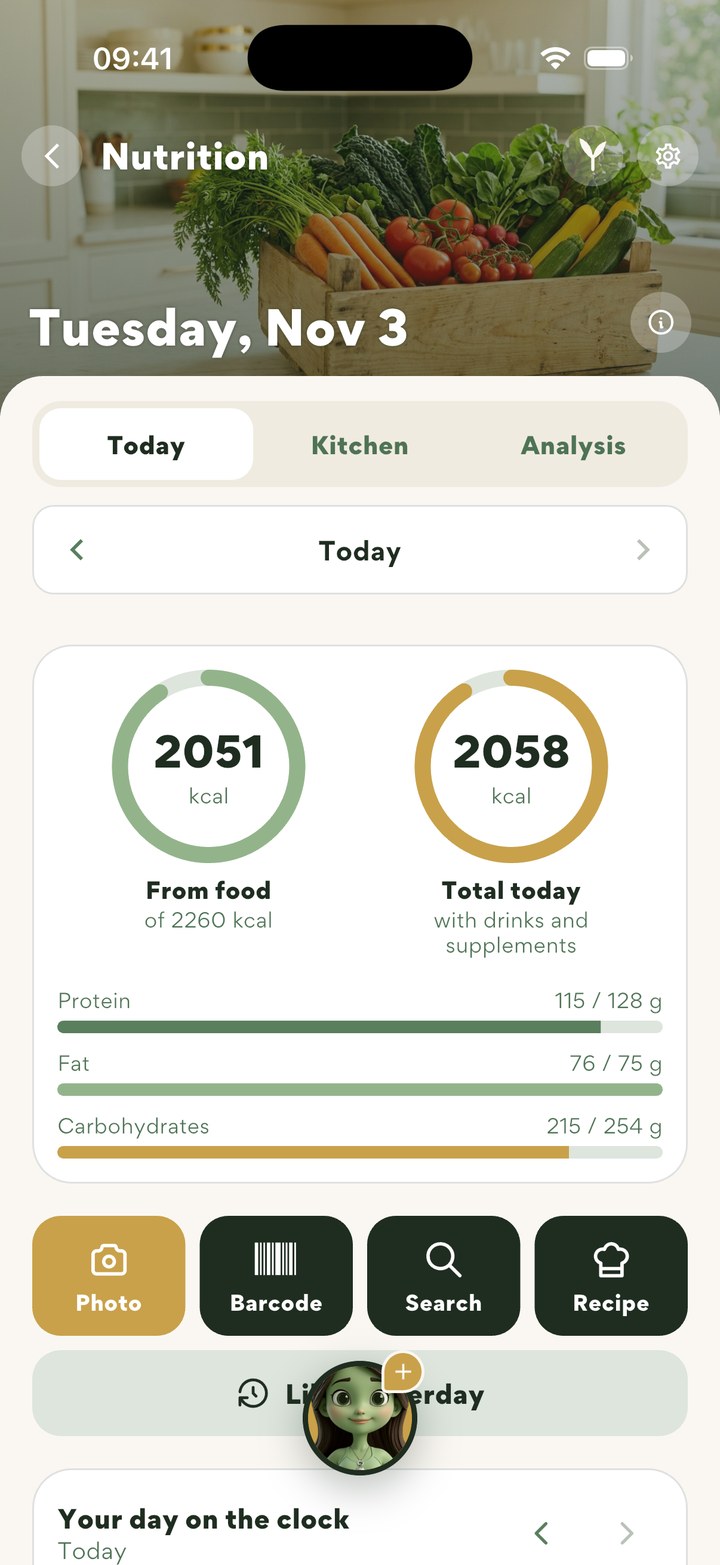
Nutrition in the app: 1420 of 2400 kcal from food, 1427 kcal in total, bars for protein, fat and carbs and buttons for photo, barcode, search and recipe
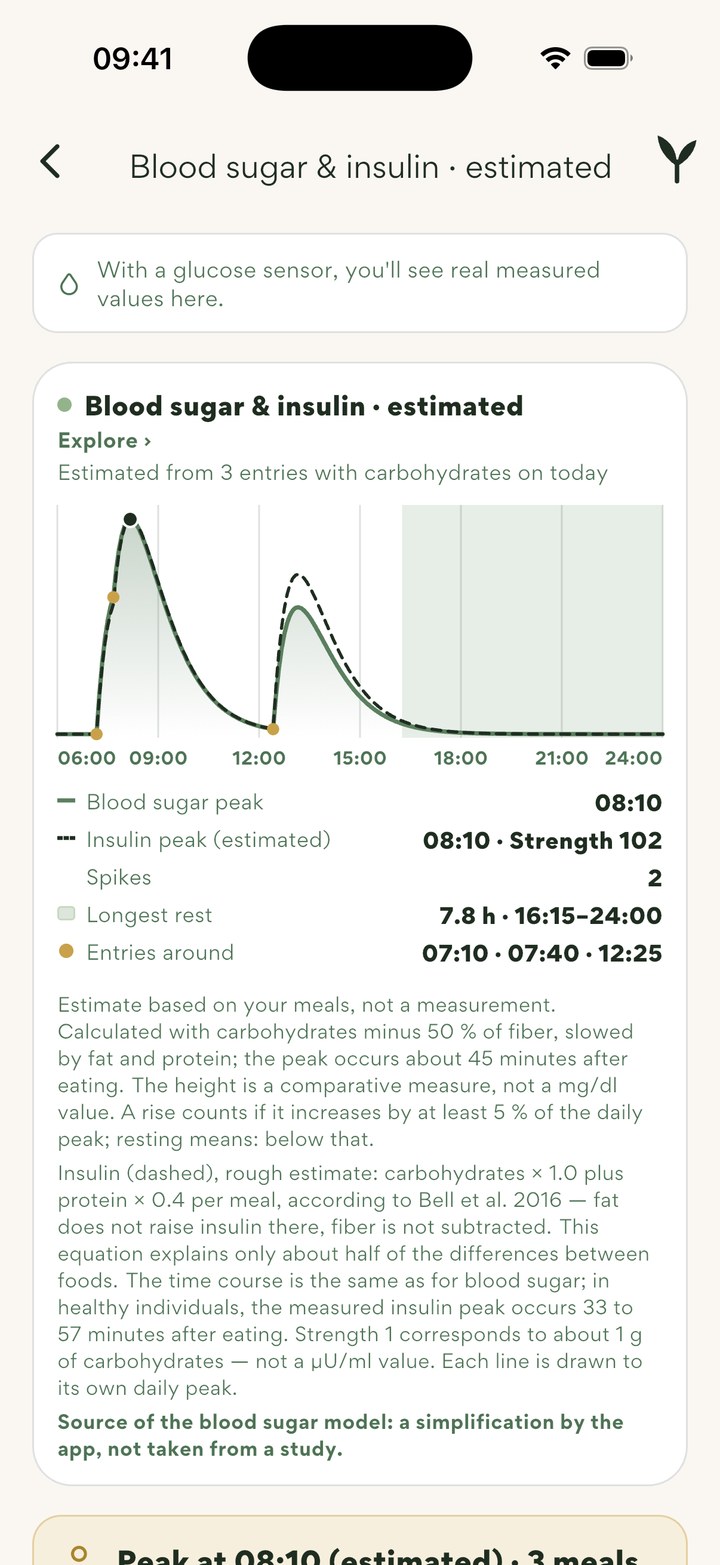
Estimated blood sugar and insulin curve for one day with two rises after breakfast and lunch and an explanation of how the app calculates it
What YUTHI keeps an eye on for you

No one-size-fits-all number: your calorie goal grows with your day.

Three examples of how the app calculates — the formulas are listed below with their sources.

How your calorie goal is built

The base is your resting metabolism from weight, height, age and sex. On top come the energy for digestion and what you burned today — measured by your watch or estimated from your entries.

Example: woman, 30 years, 65 kg, 168 cm, 800 kcal of activity

  • Resting metabolism: 10 × 65 + 6.25 × 168 − 5 × 30 − 161 = 1389 kcal8
  • Digestion: 10% of resting metabolism = 139 kcal9
  • Activity: 800 kcal, measured by the watch

= 2330 kcal on this day. On a quiet day the app shows the value of your activity slider, here 2120 kcal.

What counts on your plate

From your calorie goal the app derives your daily targets — and shows upper limits you don't have to reach.

Example: 65 kg, daily goal 2330 kcal

  • Protein · 1.6 g per kg10104 g
  • Fat · 30% of energy78 g
  • Carbohydrates · 45% of energy262 g
  • Fibre · DGE guideline11at least 30 g
  • Sugar · below 10% of energy12at most 58 g
  • Saturated fat · below 10% of energy2at most 26 g

Gold means: an upper limit, not a target. If you want to lose weight, the app subtracts 400 kcal — but never below 1300 kcal (women) or 1500 kcal (men).

Blood sugar and insulin — estimated

From your meals the app draws an estimated curve. Without a sensor you see how protein and fat slow a meal down.

  • 60 g of carbs on their own: peak 60
  • The same 60 g with 20 g protein and 20 g fat: peak 38

Calculated as in the app: carbohydrates minus half the fibre, slowed by fat and protein, peaking after about 45 minutes. This is a simplification by the app, not a measurement — the height is a comparison, not an mg/dl value. The insulin curve uses carbohydrates × 1.0 plus protein × 0.4.13

What else you can do with it

Log, cook, understand.

Log it your way

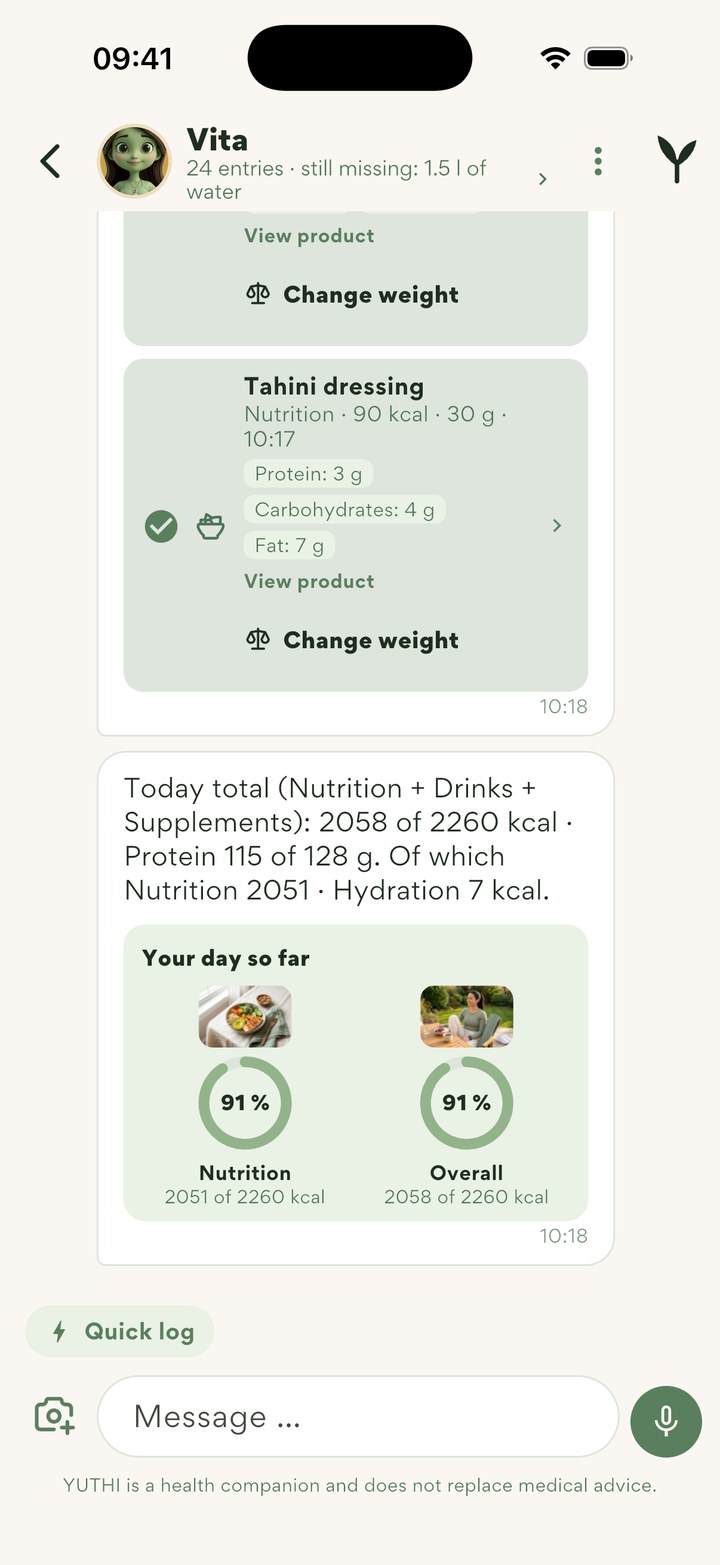
Take a photo of your plate, scan the barcode or talk to the coach: hold the microphone, say “lentil salad with feta”, let go. “Like yesterday” brings back meals from yesterday or another day last week, and you tick what you ate again. Say “my breakfast”, and it goes to breakfast — even at noon. If something ends up in the wrong meal, move it with one tap or just tell the coach.

“Lentil salad with feta”

Lentil salad with fetaLogged

  • Photo
  • Barcode
  • Search
  • Recipe
  • Like yesterday

Nutrition values come from the Swiss Food Composition Database (FSVO), the German Nutrient Database (BLS 4.0) and Open Food Facts. Photos and sentences are estimated by AI. Voice input understands the language you use the app in.

Fasting that fits you

16:8, 18:6, 20:4, 14:10 or one meal a day, plus multi-day styles such as alkaline or Buchinger fasting. Your eating window feeds straight into the meal plan.

16:8 example

  • Eating · 12–8 pm
  • Fasting · 16 hours
  • 18:6
  • 20:4
  • 14:10
  • 1 meal
  • Multi-day

Your analysis

Week, macro split, micronutrients, protein per meal and when you eat — every card opens into more detail.

WeekExample

  • 27% protein
  • 32% fat
  • 41% carbohydrates

Share of energy in an example week.

Your eating style

Everything, flexitarian, pescatarian, vegetarian, vegan or keto: the meal plan sticks to your choice.

  • Everything
  • Flexitarian
  • Pescatarian
  • Vegetarian
  • Vegan
  • Keto

Vegan selected: Every day, one nutrient that can run low is in focus — for example vitamin B12: 4 µg a day.15

Your kitchen

From plan to pot: everything works together.

Counting calories is only the start. YUTHI plans your week, writes the shopping list, knows what's in your cupboard and keeps an eye on your meal prep.

  1. 1Plan7 days, built around your goal
  2. 2ShopAmounts added up, sorted by aisle
  3. 3PantryWhat you have gets used first
  4. 4Meal prepPortions and shelf life at a glance
  5. 5EatenOne tap: into your diary and out of the pantry

And the next plan counts what's still in your pantry.

Meal plan in the app: week strip from Monday to Sunday, goal 2400 kcal and 128 g protein, a training-day note and the first meal with an “Eaten” button
Your 7-day plan
Meal prep in the app: lentil and vegetable stew in the fridge, 3 days left until Thursday, 4 of 4 portions left, a “Portion eaten” button and a storage note
Meal prep with a use-by date
Pantry in the app: nine items such as eggs, 500 g oats, 400 g red lentils and 1 kg brown rice
Your pantry
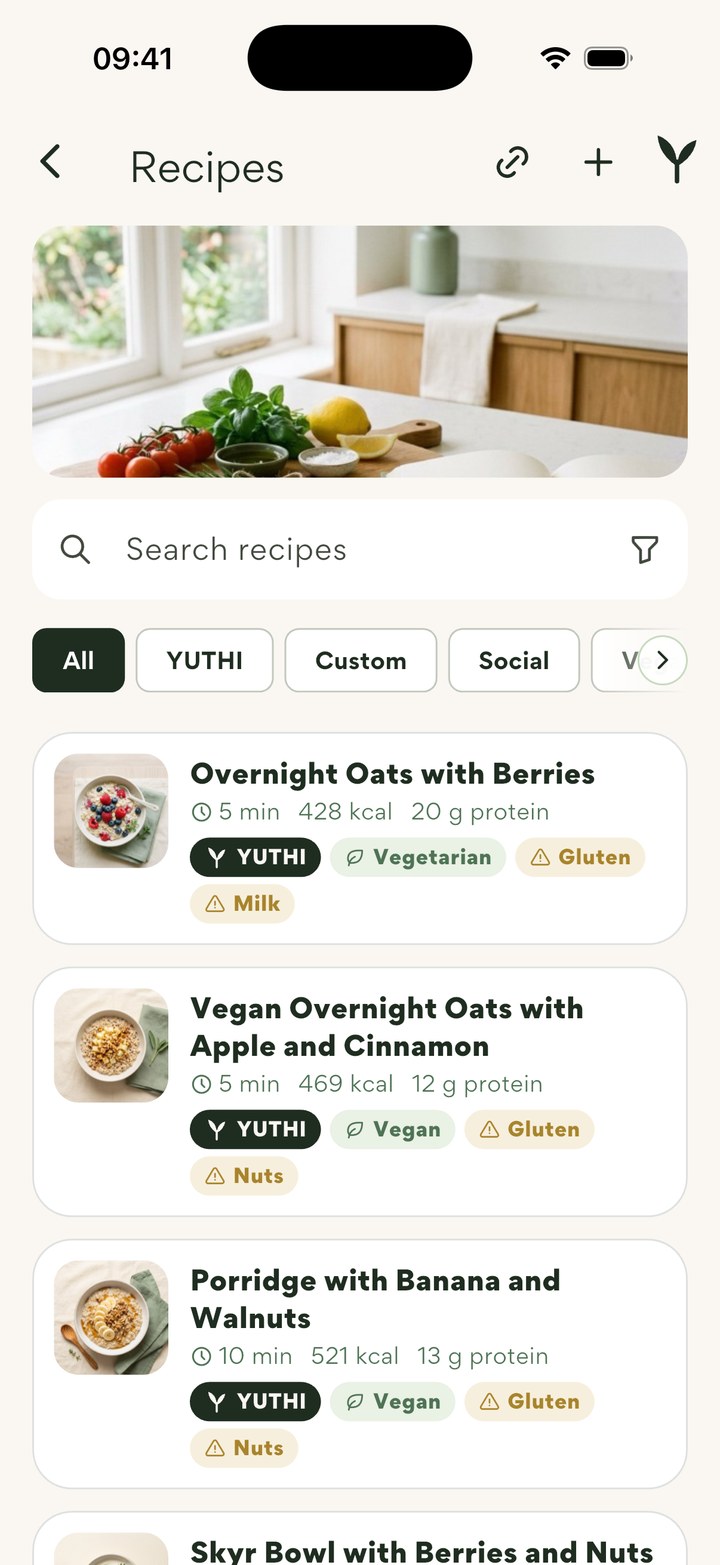
Recipes in the app: overnight oats with berries, vegan overnight oats and porridge, each with time, calories, protein, eating style and allergens
90 recipes to start

Your plan, double-checked

Built only from foods in our database, without your allergens and matching your eating style. Training days get more protein. Every day is recalculated: if it is more than 10% off your goal or more than 10 g short on protein, it gets fixed.

Example week · line = goal 2400 kcal · every day at most 10% off

Not your thing? Swap it.

One tap replaces an ingredient with another, following fixed rules:

  • Same group: vegetables stay vegetables.
  • Same calories: the amount is converted and rounded to 5 g.
  • Protein stays: at most 10% difference.
  • Your allergens stay out, swaps included.

The shopping list does the maths

It adds up the ingredients for the next 7 days, subtracts what's in your pantry and sorts everything by aisle, from vegetables to the chiller. Share it with one tap.

  • Raspberriesin 4 meals × 130 g520 g
  • Oats240 g in the plan − 100 g in the pantrybuy 140 g

Grams are subtracted from grams and millilitres from millilitres. YUTHI never converts behind your back.

Your pantry plans along

What's in your cupboard comes first in the next plan. Those dishes are marked “from your pantry”.

  1. Pantry: 500 g oats
  2. Plan: porridge with 60 g
  3. Eaten: 440 g left

Just tick it off, YUTHI subtracts the amount for you.

Meal prep with a use-by date

Log what you prepped, how many portions and whether it's in the fridge or freezer. YUTHI suggests the use-by date and counts the portions down.

  1. Moncooked · 4 portions
  2. Tueportion 2
  3. Wedportion 3
  4. Thulast day
  5. afterfreeze

Eat cooked food within 2 to 3 days or freeze it, advises the German Federal Institute for Risk Assessment.16

Recipes from anywhere

90 YUTHI recipes are already inside. Write your own, share a link from TikTok, YouTube, Pinterest or a website — or take a photo of a cookbook page, and the coach saves the recipe for you. A meal plan photo lands in your food calendar after a quick check.

  1. Share a link
  2. Ingredients and steps detected
  3. Nutrition per portion

You check everything before it's saved. YUTHI detects the 14 major allergens on its own.

Your areas talk to each other

Nutrition is connected to more than you think.

The app already calculates these connections today. A connection is not a cause — but it shows you where to look.

What does your body good

Eat Mediterranean-style

In a large Spanish trial with 7,447 people (aged 55 to 80, high cardiovascular risk), those on a Mediterranean diet (with olive oil or nuts) had fewer heart attacks, strokes or cardiovascular deaths than the comparison group.1

Fibre: whole grains, pulses, vegetables

The WHO names at least 25 g of fibre and at least 400 g of fruit and vegetables a day. A review of 185 observational studies found that people who ate the most fibre had 15 to 30 % fewer cardiovascular deaths and less type 2 diabetes than those who ate the least. The difference was clearest at 25 to 29 g a day.23

Little salt

The WHO advises adults to eat less than 5 g of salt a day (about 2 g of sodium).2

What you should rather skip

Lots of ultra-processed food

In a study with 20 adults who could eat as much as they wanted, people ate 508 kcal more a day on ultra-processed days and gained 0.9 kg in two weeks. On unprocessed food they lost 0.9 kg.4

Processed meat

The WHO's cancer research agency (IARC) classifies processed meat such as sausage and ham as carcinogenic to humans and red meat as probably carcinogenic.5

Coffee or black tea with iron-rich meals

The body absorbs iron from plants less well. Coffee and especially black tea reduce absorption, vitamin C improves it.6

More in the magazine

A new article every Friday.

All articles in the magazine
Sources
  1. Estruch R et al.: Primary Prevention of Cardiovascular Disease with a Mediterranean Diet Supplemented with Extra-Virgin Olive Oil or Nuts. N Engl J Med 2018
  2. WHO: Healthy diet (Fact sheet)
  3. Reynolds A et al.: Carbohydrate quality and human health: a series of systematic reviews and meta-analyses. Lancet 2019
  4. Hall KD et al.: Ultra-Processed Diets Cause Excess Calorie Intake and Weight Gain: An Inpatient Randomized Controlled Trial of Ad Libitum Food Intake. Cell Metab 2019
  5. Bouvard V et al.: Carcinogenicity of consumption of red and processed meat. Lancet Oncol 2015
  6. DGE: Referenzwerte für die Nährstoffzufuhr, Eisen
  7. Buffey AJ et al.: The Acute Effects of Interrupting Prolonged Sitting Time in Adults with Standing and Light-Intensity Walking on Biomarkers of Cardiometabolic Health in Adults: A Systematic Review and Meta-analysis. Sports Med 2022
  8. Mifflin MD, St Jeor ST et al.: A new predictive equation for resting energy expenditure in healthy individuals. Am J Clin Nutr 1990;51(2):241–247
  9. Westerterp KR: Diet induced thermogenesis. Nutr Metab (Lond) 2004;1:5
  10. Morton RW et al.: A systematic review, meta-analysis and meta-regression of the effect of protein supplementation on resistance training-induced gains in muscle mass and strength in healthy adults. Br J Sports Med 2018;52(6):376–384
  11. Deutsche Gesellschaft für Ernährung (DGE): Referenzwerte für die Nährstoffzufuhr — Ballaststoffe
  12. WHO: Guideline — Sugars intake for adults and children. Genf 2015
  13. Bell KJ, Petocz P, Colagiuri S et al.: Algorithms to Improve the Prediction of Postprandial Insulinaemia in Response to Common Foods. Nutrients 2016;8(4):210
  14. Hofstetter A et al.: Increased 24-hour energy expenditure in cigarette smokers. N Engl J Med 1986;314(2):79–82
  15. Deutsche Gesellschaft für Ernährung (DGE): Referenzwerte für die Nährstoffzufuhr — Vitamin B12
  16. Bundesinstitut für Risikobewertung (BfR): Fragen und Antworten — Vorkochen für mehrere Tage

Every statement comes with its source; the figures are taken from the linked studies and opinions (checked on 1 November 2026). This is context from the research, not a diagnosis and no substitute for medical advice.

Try it free now

Get YUTHI from the App Store — iPhone first, from November 2026.

Soon on theApp Store Soon onGoogle Play

Not ready yet? Let me know.